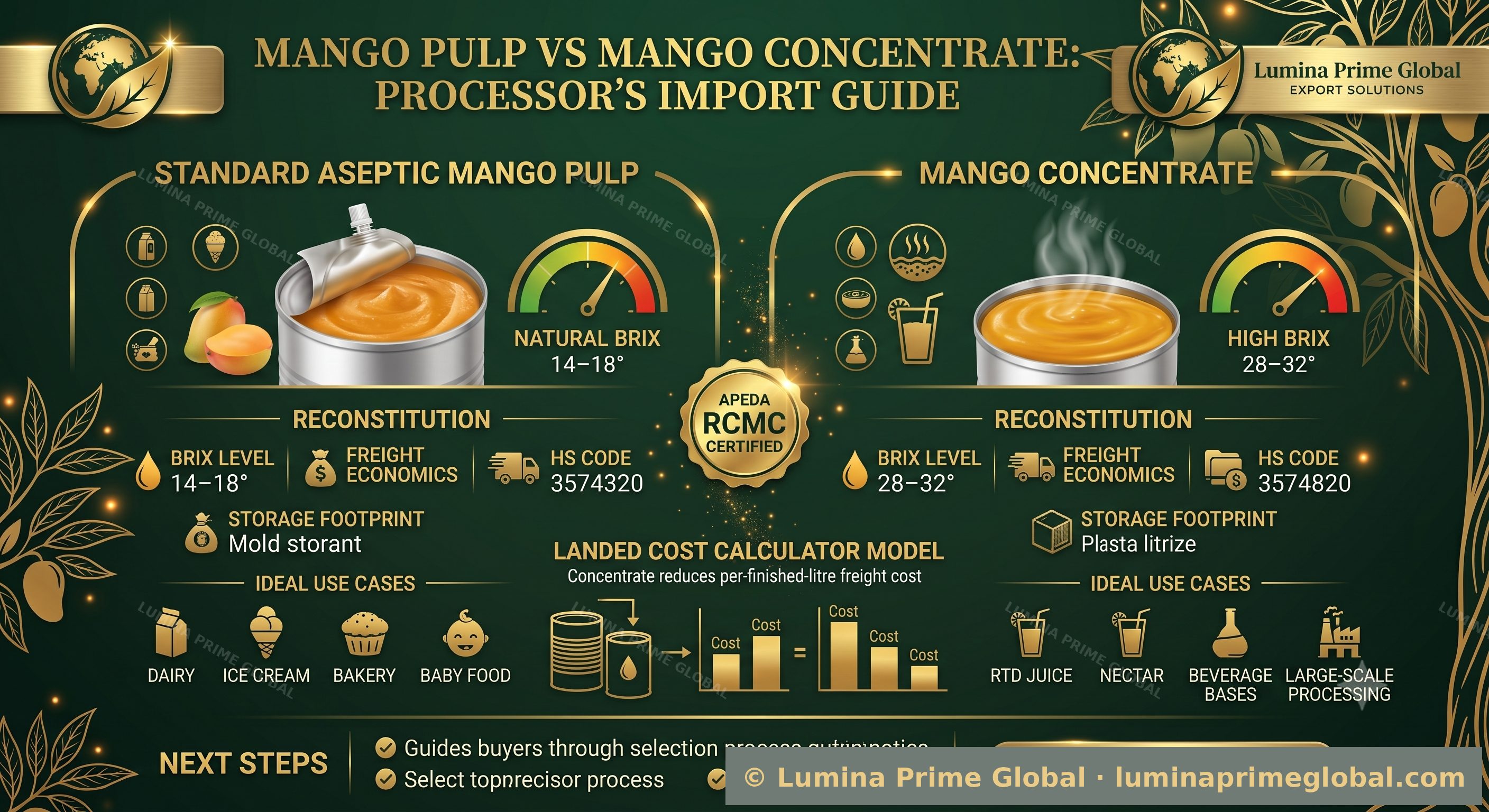
One of the most common questions we get from beverage manufacturers and food processors evaluating Indian mango suppliers isn't about variety — it's about format. Should you import standard aseptic mango pulp, or mango concentrate? The answer changes your freight cost, your reconstitution process, and in some cases your finished-product shelf life.
This guide breaks down the practical differences so you can specify the right product on your next RFQ.
Pulp Brix: 14–18° · Concentrate Brix: 28–32° · Concentrate HS Code: 2009.89 · Pulp HS Code: 2007.99 · Reconstitution ratio: ~1:1 to 1:1.2 water
1. What Actually Separates Pulp from Concentrate
Mango pulp is fruit that has been washed, deseeded, pulped, and aseptically processed at its near-natural Brix — usually 14–16° for Totapuri, 16–18° for Alphonso. Nothing is added or removed beyond straining pulp fibre and skin.
Mango concentrate starts from the same pulp, then goes through vacuum evaporation to remove a large portion of its water content, raising the Brix to 28–32°. The result is a denser, thicker product that must be diluted with water before use in most applications.
2. The Freight Economics: Why Concentrate Exists
Concentrate exists almost entirely for one reason — shipping economics. Water is heavy and takes up container space; removing it before export means you pay ocean freight only on the fruit solids, not the water you'd add back at destination anyway.
| Factor | Standard Pulp (14–16°Brix) | Concentrate (28–30°Brix) |
|---|---|---|
| Approx. finished juice yield per MT shipped | ~1 MT equivalent | ~1.9–2 MT equivalent |
| Freight cost per MT of finished product | Higher | Lower (roughly half) |
| Reconstitution required before use | Minimal / none | Yes — with potable water |
| Storage footprint per finished litre | Larger | Smaller |
For a manufacturer importing large volumes for RTD juice or nectar production, this yield difference compounds quickly across a full container order, which is why many established beverage processors default to concentrate once they scale past trial-order volumes.
3. Which Format Fits Your Application
Choose Mango Concentrate If:
- You manufacture RTD juices, nectars, or beverage bases where you already control final dilution, sugar, and acid balance
- Freight cost per litre of finished product is a primary sourcing driver
- Your facility has standardisation and blending equipment to reconstitute accurately batch-to-batch
- You need longer-distance shipping (Europe, North America) where freight cost scales with weight and volume
Choose Standard Mango Pulp If:
- You manufacture dairy products, ice cream, bakery fillings, or baby food where natural texture and mouthfeel matter
- Your process doesn't include a reconstitution/standardisation step
- You want a shorter, simpler ingredient specification with fewer processing variables
- Order volumes are smaller (1–5 MT trial range) where concentrate's freight advantage is less material
If you're a restaurant group, café chain, or small-batch dessert/dairy producer, standard aseptic pulp is almost always the right call — concentrate's freight savings only become meaningful at container-load volumes, and reconstitution adds a process step most kitchens aren't equipped to standardise consistently.
4. HS Codes & Documentation Differences
| Product | International HS Code | Typical Brix Declared |
|---|---|---|
| Standard Aseptic Mango Pulp | 2007.99 | 14–18° |
| Mango Concentrate | 2009.89 | 28–32° |
Both require the same base export documentation set — Commercial Invoice, Packing List, Bill of Lading, Certificate of Origin, Phytosanitary Certificate, FSSAI compliance, and Certificate of Analysis — but the COA for concentrate should additionally confirm Brix at the higher declared level, since customs valuation and duty in some destination markets is sensitive to declared concentration.
5. Pricing Reference (FOB Chennai, Season 2026)
| Product | Packaging | Approx. FOB Price (USD/MT) |
|---|---|---|
| Totapuri Aseptic Pulp (14–16°Brix) | 220kg drums | $600–$750 / MT |
| Totapuri Concentrate (28–30°Brix) | 220kg drums | $950–$1,200 / MT |
| Totapuri Concentrate (30–32°Brix) | 220kg drums | $1,100–$1,350 / MT |
Note: Concentrate carries a higher per-tonne FOB price but a lower cost per litre of finished beverage once reconstituted. Always model landed cost per finished unit, not just per-MT FOB price, when comparing quotes.
6. Storage & Shelf Life Considerations
- Standard pulp: 18–24 months sealed, ambient storage below 25°C, aseptic drums or pails
- Concentrate: Similar shelf life sealed, but higher Brix concentrate is more prone to sugar crystallisation if stored above 30°C for extended periods — keep in temperature-controlled warehousing where possible
- Both formats ship in standard dry containers without cold chain when properly aseptic-processed and sealed
7. Frequently Asked Questions
8. Next Steps
- Model your landed cost per finished unit — not just per-MT FOB price — for both formats
- Request samples of both if you're unsure which fits your process
- Confirm Brix and reconstitution ratio in writing on your PO/contract
- Verify APEDA RCMC and IEC of your supplier before committing volume
Lumina Prime Global supplies both standard aseptic mango pulp and mango concentrate from Chittoor — India's #1 mango processing district. APEDA RCMC certified, FOB Chennai, trial orders from 1 MT.