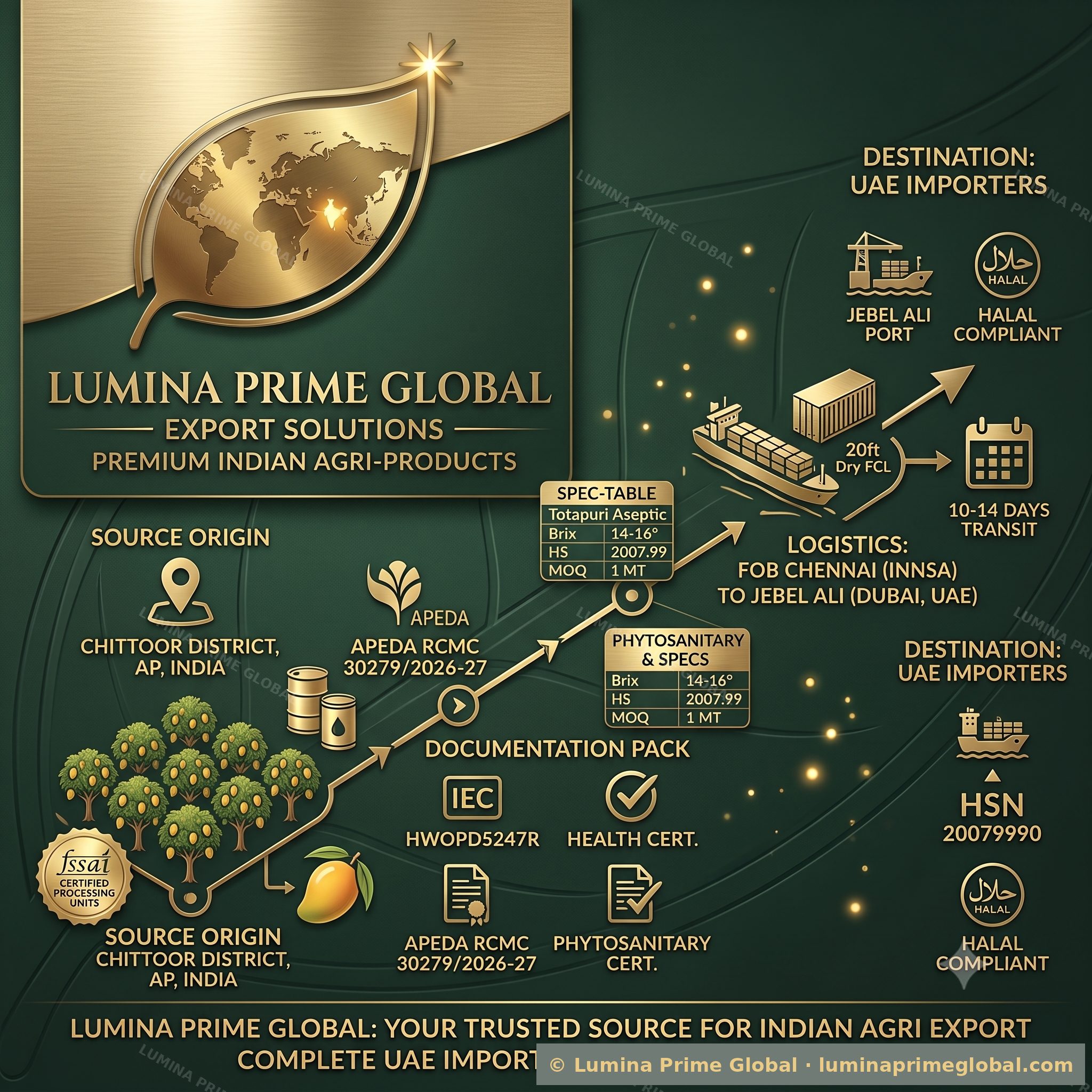
India is the world's largest producer and exporter of mango pulp, and Chittoor district in Andhra Pradesh sits at the very centre of that industry — home to 36+ FSSAI-certified processing units that supply buyers across the UAE, Saudi Arabia, Europe, and Southeast Asia.
If you're a food importer, juice manufacturer, dairy processor, or hospitality buyer in the UAE looking to source mango pulp directly from India, this guide walks you through everything: variety selection, quality parameters, HS codes, documentation, MOQ, logistics, and how to evaluate an APEDA-certified supplier.
HS Code (International): 2007.99 · HSN Code (India): 08045040 · Loading Port: Chennai (INNSA) · Transit to Jebel Ali: 10–14 days · MOQ: 1 MT trial / 20 MT FCL
1. Totapuri vs Alphonso: Which Mango Pulp is Right for Your Product?
The two dominant export varieties from India are Totapuri and Alphonso. Understanding the difference is essential before placing your first order, as they serve different end-applications and price points.
Totapuri Mango Pulp
Totapuri is the workhorse of Indian mango pulp exports — accounting for over 70% of total shipment volumes. Grown extensively across Chittoor, Krishnagiri, and Salem districts, it is processed from April to July each season.
- Flavour: Mildly tangy, less sweet than Alphonso — ideal for beverages where sugar is added in manufacturing
- Colour: Bright golden-orange (naturally vibrant without additives)
- Brix (natural sugar): 14–16° in standard grade; concentrate variants reach 28–30°
- Best for: Juice concentrates, nectars, ice cream, dairy drinks, mango lassi, baby food, baked goods, confectionery
- Price: More economical — typically 15–30% lower than Alphonso
Alphonso Mango Pulp
Alphonso (also called Hapus) is India's premium GI-tagged variety, grown in Ratnagiri and Devgad in Maharashtra. It carries a significant price premium and is sought by premium beverage and dessert manufacturers.
- Flavour: Rich, creamy, intensely sweet — the benchmark of Indian mango flavour
- Colour: Deep orange with high natural pigmentation
- Brix: 16–18°
- Best for: Premium mango juice, baby food, airline catering, 5-star hospitality, premium retail
- Season: Shorter window (March–May)
For juice manufacturing and food processing at scale, Totapuri aseptic is the right choice — consistent quality, year-round availability from cold storage, and competitive FOB pricing. For premium HoReCa or retail products, ask specifically for Alphonso and expect a premium of 20–35% over Totapuri pricing.
2. Quality Parameters & Specifications to Request
Before requesting a quote from any Indian supplier, know what specifications to ask for. This protects you when negotiating and ensures the product matches your end-use requirement.
| Parameter | Standard Grade | Premium Grade |
|---|---|---|
| Variety | Totapuri | Alphonso / Banganapalli |
| Brix (°) | 14–16° | 16–18° |
| pH | 3.5–4.2 | 3.8–4.2 |
| Colour | Golden Yellow–Orange | Deep Orange |
| Acidity (as citric) | 0.3–0.6% | 0.2–0.4% |
| TSS (Total Soluble Solids) | ≥14°Brix | ≥16°Brix |
| Preservatives | None (aseptic process) | None (aseptic process) |
| Heavy Metals | As per FSSAI / Codex | As per FSSAI / Codex |
| Pesticide Residues | Within EU/UAE MRLs | Within EU/UAE MRLs |
| Shelf Life | 18 months sealed | 18–24 months sealed |
Always request a Certificate of Analysis (COA) from the supplier's lab before finalizing your first order. A reputable exporter will also offer to dispatch a 2–5 kg sample in a sealed aseptic pouch before any commercial commitment.
3. Packaging Options: Aseptic Drums vs Frozen Pails
Indian mango pulp is exported in two primary forms: aseptic packaging and frozen packaging. The right choice depends on your storage infrastructure and end-use timeline.
Aseptic Mango Pulp (Recommended for UAE)
Aseptic processing involves high-temperature short-time (HTST) sterilization followed by filling into hermetically sealed containers under sterile conditions. No preservatives, no cold chain during transit or storage.
- 220 kg aseptic steel drums — standard FCL export format, ~80–85 drums per 20ft container
- 25 kg aseptic pails — suited for trial orders, smaller processors, or retail repacking
- Shelf life: 18–24 months at ambient temperature (below 25°C preferred)
- No cold chain required for sea freight — significant cost advantage for UAE buyers
Frozen Mango Pulp (IQF / Block Frozen)
Suitable if your facility has deep-freeze storage. Retains slightly better fresh flavour profile but requires continuous cold chain from India to your facility.
- Typically in 25 kg polylined cartons
- Requires reefer container (adds freight cost of USD 800–1,500 per container vs dry container)
- Storage: -18°C; shelf life 12–18 months frozen
4. HS Code & Indian HSN Code
Getting the HS code right is critical for customs clearance on both the Indian export side and the UAE import side. Incorrect HS codes can cause delays, duty miscalculations, or rejection at port.
| Code System | Code | Description |
|---|---|---|
| International HS (6-digit) | 2007.99 | Jams, fruit jellies, marmalades, fruit or nut purée and pastes — other (incl. mango pulp) |
| India HSN (8-digit) | 20079990 | Other jams, jellies, marmalades, purées — processed mango pulp |
| India HSN (alternate) | 08045040 | Fresh or dried mango (used for fresh mangoes; sometimes applied to pulp by smaller exporters — confirm with your supplier) |
| UAE HS (import) | 2007.99.00 | Standard classification for processed mango pulp imports into UAE |
Some exporters incorrectly classify mango pulp under 0804.50 (fresh mangoes) which can create issues at UAE customs. Always verify the HS code on the commercial invoice and packing list matches 2007.99 for processed mango pulp — ask your supplier's documentation team to confirm before shipment.
5. Export Documentation Checklist
UAE customs requires a specific set of documents for food imports. A professional APEDA-registered exporter will provide all of these as standard with every shipment:
- Commercial Invoice — with HS code, unit price (USD/MT), total value, Incoterms, and seller/buyer details
- Packing List — number of drums/pails, net weight, gross weight, drum numbers, container/seal number
- Bill of Lading (BL) — issued by the shipping line at Chennai port; original set of 3 required
- Certificate of Origin (COO) — issued by APEDA or Chamber of Commerce; required by UAE customs to confirm Indian origin
- Phytosanitary Certificate — issued by India's Plant Quarantine authority; mandatory for all food imports into UAE
- FSSAI Certificate of Compliance — confirms the product meets India's food safety standards
- Health Certificate — issued by the Food Safety Commissioner (state-level); increasingly required for GCC imports
- Certificate of Analysis (COA) — lab report showing Brix, pH, acidity, heavy metals, pesticide residues
- APEDA RCMC — confirms the exporter is registered with APEDA (Agricultural and Processed Food Products Export Development Authority)
- Halal Certificate (optional but recommended for UAE) — issued by a ESMA-recognized Halal body
6. Logistics: FOB Chennai to Jebel Ali (UAE)
Understanding the logistics chain helps you plan your order lead time and negotiate the right Incoterms with your supplier.
Incoterms Options
Three Incoterms are commonly used for India-UAE mango pulp shipments:
- FOB Chennai — exporter delivers to vessel at Chennai port. You arrange and pay for sea freight + insurance from Chennai onwards. Gives you control over the freight cost and shipping line.
- CIF Jebel Ali — exporter covers cost + insurance + freight to your destination port. Simpler for first-time buyers but you lose control over freight rates and insurance provider.
- CFR Jebel Ali — cost + freight only, buyer arranges insurance. Middle ground.
Transit Time
| Destination Port | Transit Time | Shipping Lines |
|---|---|---|
| Jebel Ali (Dubai, UAE) | 10–14 days | MSC, CMA CGM, Maersk |
| Khalifa Port (Abu Dhabi) | 12–16 days | MSC, Evergreen |
| King Abdulaziz (Dammam, KSA) | 12–15 days | MSC, CMA CGM |
| Shuwaikh (Kuwait) | 14–18 days | MSC, APL |
Container Sizing & Load
- 20ft Dry Container (FCL): Approx. 18–20 MT of mango pulp in 220kg aseptic drums (80–85 drums)
- 20ft Dry Container (FCL): Approx. 16–18 MT in 25kg pails
- LCL (Less than Container Load): Available for trial orders below 5 MT — higher per-unit freight cost but lower total outlay
7. How to Evaluate an APEDA-Certified Mango Pulp Exporter
India has thousands of mango pulp exporters. Not all of them maintain consistent quality, documentation standards, or export compliance. Here's what to check before committing to a supplier:
- Verify the supplier's APEDA RCMC number on the official APEDA website (apeda.gov.in). The RCMC confirms they are registered to export agri-products from India.
- Ask for the supplier's IEC (Import Export Code) issued by DGFT — all legitimate exporters have one.
- Request previous shipment BL copies — a genuine exporter will have documented shipping history to GCC markets.
- Confirm FSSAI license number and verify it is current (licenses are renewed annually).
- Request processing unit photos or a facility video — aseptic mango pulp requires significant capital equipment. No proper factory = no proper aseptic process.
- Ask about third-party lab testing — reputable exporters test each batch at NABL-accredited labs for pesticide residues and heavy metals.
- Confirm COA with each lot number — not a generic document but specific to your order batch.
8. Pricing Benchmarks (FOB Chennai, Season 2026)
Pricing varies by season, variety, grade, and order volume. The below figures reflect typical FOB Chennai benchmarks for Season 2026. Always request a fresh quote as mango prices shift with harvest conditions.
| Product | Packaging | Approx. FOB Price (USD/MT) |
|---|---|---|
| Totapuri Aseptic Pulp | 220kg drums | $600–$750 / MT |
| Totapuri Aseptic Pulp | 25kg pails | $750–$900 / MT |
| Totapuri Concentrate (28–30°Brix) | 220kg drums | $950–$1,200 / MT |
| Alphonso Aseptic Pulp | 220kg drums | $900–$1,200 / MT |
| Alphonso Aseptic Pulp | 25kg pails | $1,100–$1,400 / MT |
Note: Prices above are indicative benchmarks. Actual pricing depends on Brix specification, packaging, order quantity, and season. Request a formal quote directly for current pricing.
9. Frequently Asked Questions
10. Ready to Source? Your Next Steps
If you're a UAE food importer, juice manufacturer, or hospitality buyer looking to establish a reliable mango pulp supply chain from India, here's a practical starting point:
- Define your spec — variety (Totapuri/Alphonso), form (aseptic/frozen), Brix range, packaging size
- Request a sample — any serious exporter will send a 2–5 kg sample; evaluate colour, flavour, Brix before committing
- Verify APEDA RCMC and IEC — on apeda.gov.in and dgft.gov.in respectively
- Get a formal FOB quote — specify quantity, packaging, destination port, and required documents
- Arrange UAE import clearance — engage a licensed customs broker in Jebel Ali
- Place a trial order — 1–2 MT to verify quality before scaling to full FCL
Lumina Prime Global is an APEDA RCMC-certified B2B exporter based in Chittoor — India's #1 mango pulp district. IEC: HWOPD5247R · APEDA RCMC: 30279/2026-27 · GSTIN: 37HWOPD5247R1ZJ.