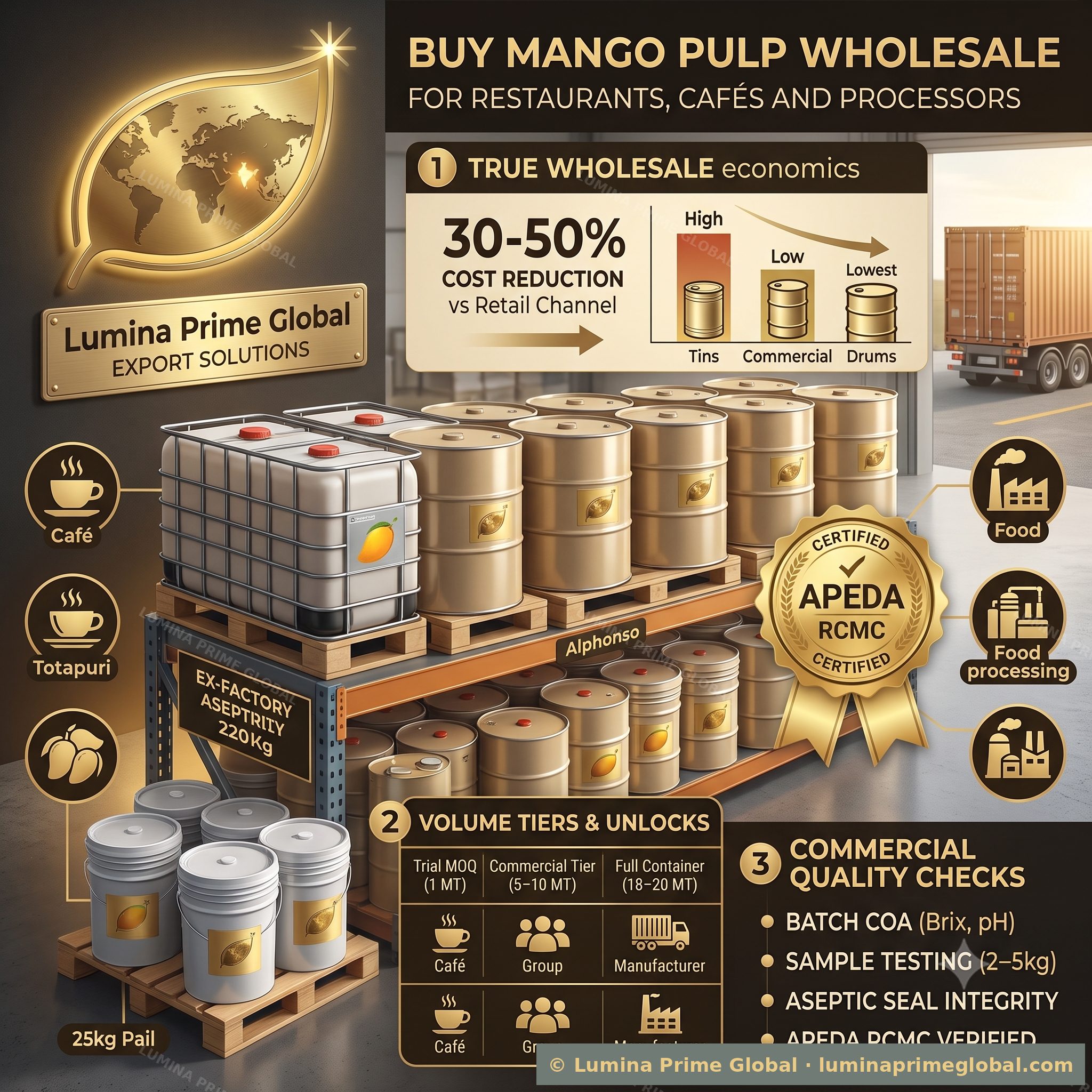
If your restaurant group, café chain, juice bar, or food processing operation is still buying mango pulp in retail tins from a distributor, you're very likely overpaying — often by 30-50% per kg — for packaging and margin layers you don't need at commercial volume.
This guide covers how to move to true wholesale sourcing: what volume tiers unlock better pricing, what quality checks protect you, and how to evaluate a supplier before committing.
Trial MOQ: 1 MT · Commercial tier: 5–10 MT · Full container: 18–20 MT · Packaging: 25kg pails or 220kg drums · Shelf life: 18–24 months sealed
1. Industrial-Grade vs Retail Mango Pulp
The single biggest cost lever for a commercial buyer is understanding that retail and industrial mango pulp are different supply chains entirely, not just different pack sizes.
- Retail mango pulp — sold in 400g–850g consumer tins or pouches through supermarkets and general distributors. Priced to cover retail packaging, branding, distribution margins, and shelf placement fees. Convenient for very low volume, but a poor economic fit once you're buying regularly.
- Industrial/commercial-grade mango pulp — supplied in 25kg aseptic pails or 220kg drums directly from an APEDA-registered exporter or processing unit, with no retail packaging or brand markup. This is the correct channel once your monthly usage exceeds roughly 100-200kg.
If you're currently buying more than 5-10 retail tins per week, you're very likely paying a meaningful premium versus sourcing the same product in bulk aseptic packaging. Most restaurant groups and café chains that switch to direct wholesale sourcing see per-kg cost drop by 30-50%.
2. Volume Tiers & What They Unlock
| Order Tier | Typical Buyer | Packaging |
|---|---|---|
| 1 MT (trial) | Single restaurant, café, first-time buyer testing quality | 25kg aseptic pails (40 units) |
| 5–10 MT | Restaurant group, regional café chain, small-batch processor | 25kg pails or mixed pail/drum |
| 18–20 MT (Full Container) | Mid-size processor, distributor, large hospitality group | 220kg aseptic drums (80–85 units) |
| Multiple FCL / seasonal contract | Beverage manufacturer, national foodservice chain | 220kg drums, seasonal supply agreement |
Pricing typically steps down meaningfully between the 1 MT trial tier and the 5-10 MT commercial tier, and again at full container load — so it's worth planning your order size around your actual annual usage rather than ordering small and often.
3. Quality Checks Before You Commit Volume
Commercial buyers should apply the same diligence as an importer, even for domestic or regional bulk purchases:
- Request a Certificate of Analysis (COA) confirming Brix, pH, and absence of added preservatives
- Ask for a 2–5 kg sample in sealed aseptic packaging before placing a commercial order
- Verify the supplier's FSSAI license and, for export-linked supply chains, their APEDA RCMC registration
- On arrival, check seal integrity of the aseptic drum or pail — any compromised seal means the product should not be used
- Confirm the variety and Brix match your specification — Totapuri for standard applications, Alphonso for premium menu items
- Ask about batch traceability — a proper commercial supplier can trace any drum back to its processing date and lot
4. How Cost Scales With Volume (Illustrative)
| Volume | Approx. Cost per kg (ex-factory/FOB basis) | Notes |
|---|---|---|
| Retail tins (400–850g) | Highest per-kg cost | Includes retail packaging & distribution margin |
| 1 MT trial (25kg pails) | Moderate | Small-batch aseptic packaging, no retail markup |
| 5–10 MT | Lower | Commercial pricing tier |
| 18–20 MT (FCL, 220kg drums) | Lowest per-kg cost | Full container efficiency, bulk drum packaging |
Figures above are directional to illustrate scaling — request a formal quote for current pricing based on variety, Brix, and destination.
5. Where Restaurants & Processors Actually Source From
In practice, commercial buyers source mango pulp through one of three channels:
- Direct from an APEDA-registered exporter/processor — best pricing, requires meeting MOQ and managing your own logistics or working with the exporter's distribution arrangement
- Regional wholesale distributor — convenient for smaller, more frequent orders below MOQ thresholds, at a moderate markup over direct sourcing
- Retail/general trade — only practical for very low, irregular volume; not cost-effective for any recurring commercial use
For restaurant groups and processors with predictable monthly usage, going direct — even starting with a 1 MT trial order — is almost always the better long-term arrangement once volume justifies it.
6. Frequently Asked Questions
7. Next Steps
- Estimate your monthly/annual usage to identify which volume tier fits
- Request a sample and COA before your first commercial order
- Verify supplier credentials — FSSAI license and APEDA RCMC number
- Start with a 1 MT trial to confirm quality and consistency before scaling
Lumina Prime Global supplies wholesale mango pulp — Totapuri and Alphonso, aseptic and frozen — direct from Chittoor, India's #1 mango processing district. APEDA RCMC certified, trial orders from 1 MT.