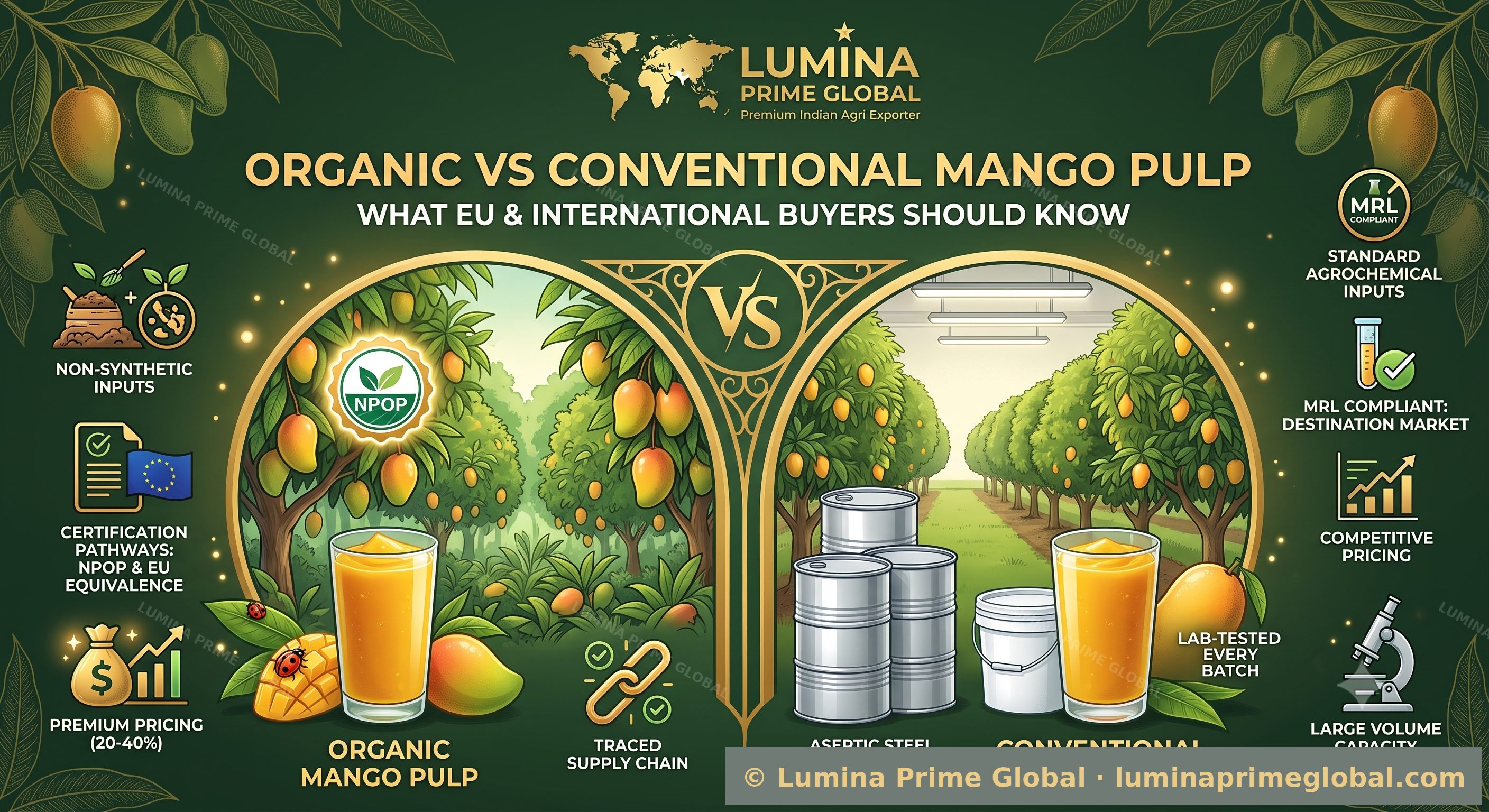
For buyers selling into health-conscious or premium retail channels — particularly the EU, where organic demand continues to grow — the choice between organic and conventional mango pulp affects certification requirements, cost, and supply lead time. Here's what actually differs, beyond the label.
Typical premium: 20–40% over conventional · EU certification: NPOP with EU equivalence, or EU Reg. 2018/848 · Conversion period for new orchards: 2–3 years
1. What Actually Differs
Organic and conventional mango pulp start from the same fruit varieties and go through the same aseptic processing method — the difference lies entirely in orchard practices and certification, not the pulping process itself.
| Factor | Organic | Conventional |
|---|---|---|
| Pest/weed management | Non-synthetic inputs only | Standard agrochemical inputs, MRL-compliant |
| Certification required | NPOP / EU Reg. 2018/848 or equivalent | None (MRL/FSSAI compliance still required) |
| Typical yield per orchard | Lower | Higher |
| Price position | 20–40% premium | Standard market pricing |
| Processing method | Same aseptic process | Same aseptic process |
| Brix / flavour | Comparable to conventional | Comparable to organic |
2. Certification Pathways for Export
For a shipment to legally carry "organic" claims in the destination market, certification has to be verifiable at each stage:
- NPOP (National Programme for Organic Production): India's domestic organic certification standard, administered under APEDA
- EU equivalence: NPOP has equivalence recognition with the EU under certain conditions — confirm this applies to your specific supplier and certifying body before contracting
- Direct EU Regulation 2018/848 certification: Some exporters additionally hold direct EU organic certification through an EU-recognised control body, which removes any equivalence ambiguity
- USDA NOP: For the US market, confirm the supplier holds USDA-recognised organic certification, which is a separate process from NPOP/EU
Always request the certifying body's name and certificate number, and cross-check it against the relevant government or regulatory database (APEDA for NPOP, the EU's organic operator database for EU-recognised certifiers) rather than accepting a certificate copy at face value.
3. Why Organic Carries a Premium
- Lower yield: Non-synthetic pest and weed management typically results in more crop loss and lower output per hectare
- Higher labour input: Manual weeding, composting, and biological pest control require more labour than chemical alternatives
- Certification and audit costs: Annual inspection and certification maintenance fees are passed through the supply chain
- Segregated processing and storage: Organic product must be kept separate from conventional stock throughout handling, adding logistics overhead
4. Conventional Doesn't Mean Unregulated
It's worth noting that conventional mango pulp exported to regulated markets like the EU or US still requires Maximum Residue Limit (MRL) compliance, verified through pesticide residue lab testing on export batches. "Conventional" refers to standard agricultural practice within regulatory limits — not an absence of quality or safety oversight.
5. Which Should You Choose
- Choose organic if: your finished product is marketed on an organic claim, you're selling into a retail channel where organic certification drives purchase decisions, or your brand positioning requires it
- Choose conventional if: cost efficiency is the primary driver, your finished product doesn't carry an organic claim, or your formulation blends multiple ingredients where an organic claim isn't feasible anyway
6. Frequently Asked Questions
7. Next Steps
- Decide if your finished product needs an organic claim — this drives the entire sourcing decision
- Request the supplier's certificate number and verify it against the relevant regulatory database
- Confirm segregated handling if ordering organic alongside conventional stock
- Factor in premium pricing and any longer lead times for organic-certified lots
Lumina Prime Global supplies both conventional and certified-organic mango pulp from Chittoor, with full traceability and lab-verified MRL compliance on every export batch.